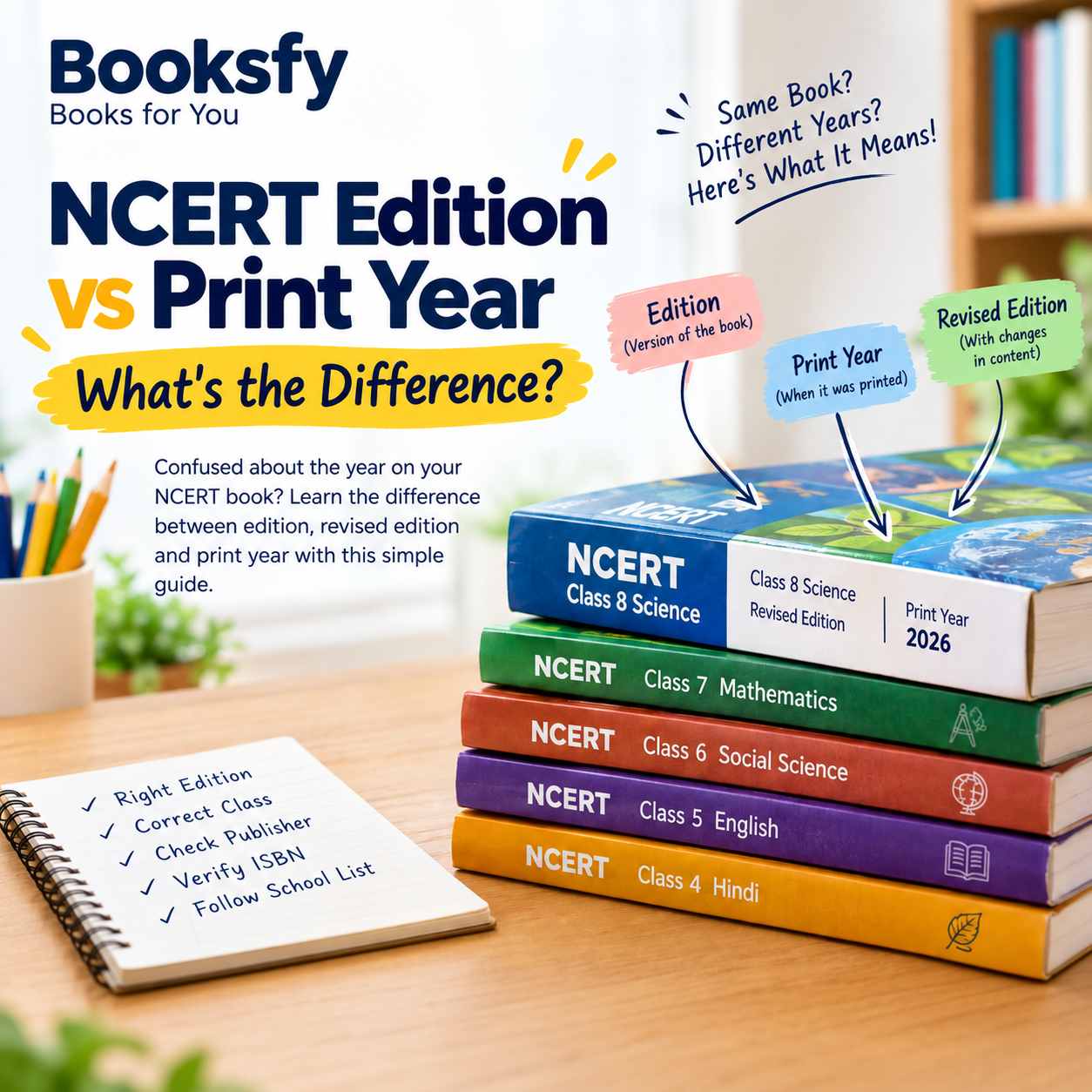
Confused about the year mentioned on your NCERT book?
If you see a year such as 2024, 2025 or 2026 on an NCERT textbook, you may wonder: Is this a new edition? Has the syllabus changed? Should I buy the latest year?
The answer is not always yes.
For students and parents buying NCERT books online, understanding the difference between an edition, revised edition, and print year can help avoid confusion and ensure that you order the correct textbook.
In this guide, Booksfy explains these terms in simple language.
What Does "Edition" Mean in an NCERT Book?
An edition generally refers to a particular version of a book.
When significant changes are made to the content, structure, chapters, syllabus alignment, or other important parts of a textbook, a new edition may be published.
For example, a book may be identified as a particular edition, and a later edition may contain changes compared with the earlier version.
However, a new printing year does not automatically mean that the book is a new edition.
This is one of the most common points of confusion when buying NCERT books.
What Does "Print Year" Mean?
The print year tells you when that particular copy or printing of the book was produced.
For example, you may find:
- Printed in 2024
- Printed in 2025
- Printed in 2026
A newer print year does not necessarily mean that the entire content of the book has been changed.
A book can continue to be the same edition while being printed again in a later year.
Simple Example
Imagine a textbook is published as a particular edition in 2025.
If NCERT prints more copies of that same edition in 2026, the book may show 2026 as the print year while still belonging to the same edition.
So:
New print year ≠ automatically new edition
What Is a Revised Edition?
A revised edition indicates that changes have been made to the content or structure of the earlier version.
Depending on the textbook, these changes may involve chapters, topics, exercises, illustrations, corrections or other curriculum-related updates.
When buying school books, students and parents should therefore look at the edition information and the applicable school/curriculum requirements, rather than assuming that the highest year printed on a book is always the correct choice.
Does a New Print Year Mean the Syllabus Has Changed?
Not necessarily.
This is an important point.
Suppose a textbook has a print year of 2026. That alone does not prove that the syllabus has been revised.
The year printed on the book primarily tells you about the printing of that copy. To determine whether the content or syllabus has changed, you should check the relevant official textbook/curriculum information and your school's prescribed book list.
Why Do Parents Get Confused While Buying NCERT Books Online?
When shopping online, customers often see different years mentioned in product listings or book photographs.
For example:
NCERT Class 8 Science — 2025
NCERT Class 8 Science — 2026
This can naturally create a question:
"Which one should I buy?"
The answer depends on what those years represent.
They could refer to:
- Different print years
- Different editions
- A revised edition
- Different stock batches
- Or, in some cases, an actual change in the textbook
Therefore, the year alone should not be the only factor used to decide whether a book is correct.
How to Check Whether You Have the Correct NCERT Book
Before purchasing an NCERT textbook, check the following information:
1. Class
Make sure the book is meant for the correct class.
For example:
Class 7 Science is different from Class 8 Science, even if the subjects have similar names.
2. Subject
Check the exact subject name.
This is particularly important for higher classes where students may have multiple subject options.
3. Book Title
Compare the title with the book list provided by your school or the relevant official source.
4. Edition Information
If an edition is specified, compare it carefully with the edition required for your course.
5. Publisher
Check that the book is published by the organisation/publisher specified for your curriculum.
6. ISBN
An ISBN is a unique identifier used for a specific book edition/product. Checking the ISBN can be useful when you want to make sure you are ordering the exact book.
7. School Book List
For school students, the school's current book list should be one of your primary references.
If there is any doubt, confirm with the school before ordering.
Is an Older Print Year Always a Problem?
No.
A lower print year does not automatically mean that a book is incorrect or outdated.
The important question is whether the book is the correct edition/version prescribed for the student's course.
Similarly, a newer print year does not automatically mean that it contains a new syllabus.
This is why simply choosing the book with the highest year is not always the right approach.
Should You Always Buy the Latest-Year NCERT Book?
Not necessarily.
Instead of asking:
"Which book has the latest year?"
it is better to ask:
"Which edition/version is currently applicable to my class and syllabus?"
For school students, the safest approach is to compare the book with the school's current book list and the relevant official information.
If a revised edition has been introduced, the school or official curriculum information should indicate the applicable version.
What Is the Difference Between Edition, Reprint and Print Year?
Here's a simple way to understand it:
| Term |
What it generally means |
| Edition |
A particular version of a book |
| Revised Edition |
An edition containing changes from an earlier version |
| Print Year |
The year in which a particular printing was produced |
| Reprint |
Another printing of an existing edition |
The exact information printed on a textbook can vary, so always check the book itself and the relevant official information.
A Simple Checklist Before Ordering NCERT Books Online
Before clicking Buy Now, take a moment to check:
☑ Correct class
☑ Correct subject
☑ Correct title
☑ Correct publisher
☑ Correct edition/version where applicable
☑ ISBN, if available
☑ Current school book list
☑ Product description
☑ Return/replacement terms
This small checklist can prevent many common ordering mistakes.
What If You're Still Confused?
If you are unsure whether two books with different years are actually different editions, don't decide based only on the year printed on the cover.
Instead:
- Check the edition information.
- Compare the ISBN where available.
- Check the current school book list.
- Check the relevant official textbook information.
- Ask your school if there is still uncertainty.
This is especially useful when schools update their prescribed books or when curriculum changes are introduced.
Frequently Asked Questions
Is a 2026 NCERT book always newer than a 2025 NCERT book?
Not necessarily. The year may indicate the print year rather than a completely new edition.
Does a new print year mean the syllabus has changed?
No. A new print year by itself does not establish that the syllabus or content has changed.
What is more important: edition or print year?
When determining whether a textbook is the correct version, the applicable edition/version and curriculum requirements are generally more informative than the print year alone.
How can I check whether my NCERT book is correct?
Check the class, subject, title, publisher, edition/version, ISBN where available, and compare the book with your school's current book list.
Should parents always buy the book with the latest year?
No. The latest print year is not automatically the same thing as a new edition. Check which version is actually required.
Final Takeaway
The next time you see a year printed on an NCERT textbook, don't immediately assume that it means a new edition.
Remember:
Print Year tells you when a copy was printed.
Edition tells you which version of the book it belongs to.
For students and parents, the most important thing is to buy the correct textbook for the current class, subject, curriculum and school requirement.
At Booksfy, our goal is to make buying school and educational books simpler and more convenient for students and parents across India.
Looking for NCERT and school books online? Explore the available books on Booksfy and always compare your selection with your school's latest book list before placing an order.